2024 Election Guide and Predictions

What to watch for early on Election Night
The first states to close their polls are Indiana and Kentucky, which close at 6 EST. While those states are obviously not competitive, some areas in the two states could still offer clues as to how other demographically similar places in swing states will vote.
The first example is Hamilton County, Indiana. Hamilton – a suburban county outside Indianapolis - has a much higher college education attainment (over 60 percent have a bachelor’s degree or higher) than the rest of the state. The second example is Fayette, Kentucky, which includes Lexington and the University of Kentucky. A little over 50 percent have a bachelor’s degree or higher. The last example from these two states is Lake, Indiana, though the polls close at 7 EST here rather than 6. Lake has a mix of urban, suburban, and rural areas and borders Illinois. It was a big manufacturing hub and was heavy with steel industries, though that has declined over the years.
In 2012, Romney won Hamilton County by about 34 points even as he only won the state by a little over ten points (the coalitions of each party were, of course, very different pre-Trump). In 2020, Trump only won Hamilton by seven points and Biden received 45% of the vote, the highest by a Democrat at the presidential level ever. In 2012, Obama narrowly carried Fayette. In 2016, Clinton won here by ten points and in 2020 Biden more than doubled that, winning Fayette by 21 points reaching 59%, the highest for a Democrat ever. Obama won Lake County by 31 points in 2012, but it has swung to the right since then with Biden only winning by 16 points. If Harris performs better in Hamilton and in Fayette, it is a sign she will do stronger than Biden in these highly college educated suburban counties. Additionally, if she can maintain about a 16-20 point edge here it could there is not serious erosion in right trending counties which have an urban, suburban and rural combo.
Do not to read into Florida’s results since it is not a harbinger of things to come for either candidate or show clues to voting patterns in other states. It will likely vote more Republican at the presidential level than it has since 2004 when Bush won it by five points. The one exception may be Osceola County - which elections expert Steve Kornacki of NBC News mentioned on a Pod Save America podcast released Nov 3 - because of the high Puerto Rican population there. It is a majority Hispanic county and about one-third is Puerto Rican. Obama and Clinton cracked sixty percent, but in 2020, Biden only won by 14 here. In light of the offensive “floating island of garbage” controversy, it is worth watching if Osceola shifts back to the left.
Poll Closing Times and When We Should Expect Results in Swing States
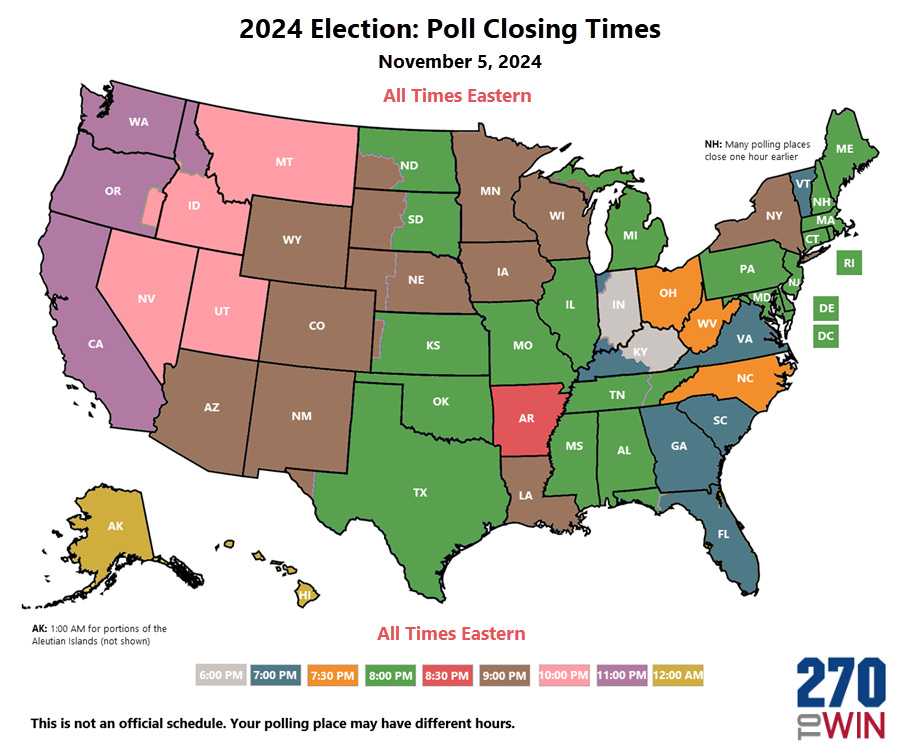
Here is a list of the poll closure times in the core seven swing states in order of first to last and below is a map of poll closings in all fifty states, all listed in eastern standard time in the list and the map.
- Georgia at 7
- North Carolina at 7:30
- Pennsylvania and Michigan at 8
- Wisconsin at 9
- Arizona at 9
- Nevada at 10.
According to the Atlanta Journal Constitution, Georgia election law requires all early votes (expected to be about 70 percent of the total vote share) and most absentee votes be tallied within an hour of the polls closing, so by 8pm we will have results of about 75 percent of Georgia’s votes. Ballots cast on Election Day will be counted nonstop until each county is done.
In North Carolina, in the past, early voting would be tabulated before the polls open and they’d be reported immediately after poll closed at 7:30. Now, election officials must wait until 7:30 to begin the process of counting and reporting early votes, which the NC Board of Elections says could take 30-60 minutes. The first reported votes will be mail-in, then early in-person, then Election Day votes. They still count quickly, and I assume over 90 percent, and potentially nearly all votes could be reported by midnight on Election Day.
Pennsylvania was not called for President Biden until four days after Election Day in 2020, but it is expected to go faster this time for a couple reasons: there is newer, faster equipment in use since 2020 and a requirement that most counties continue counting mail ballots without stopping after polls close, including through the night. Allegheny County, a heavily Democratic County which includes Pittsburgh, is known for reporting results quickly though Philadelphia County is slower. Hopefully by midnight it is closer to the 87 percent reported in 2022 by than the 54 percent reported by midnight in 2020.
Michigan made significant improvements to its vote counting and reporting since 2020. According to the AP, cities and townships now can run absentee ballots through tabulator machines starting eight days before the election. Secretary of State Jocelyn Benson recently told reporters she expected the state's unofficial results to be known on Wednesday, Nov. 6. Only about half of votes cast were reported by midnight in 2020 and 2022, but hopefully we will have more by midnight this cycle. In 2020, 71 percent of votes cast were reported by midnight and in 2022 it was 86 percent. Hopefully it is somewhere between those figures this time. According to @umichvoter on Twitter, a close observer of Michigan elections, Detroit will release results for the 100,000 ballots received before Election Day in a first batch after 8pm.
Unfortunately, Wisconsin state law does not allow election workers to start processing, opening or sorting mail ballots until Election Day here, though they are required to count through the night until finished. In 42 cites, including Milwaukee, absentee ballots are counted at a central facility and are reported in large batches. A final tally isn’t expected until the morning after Election Day.
In Arizona, early in-person ballots and mail-in ballots received the weekend before the election will be reported first, usually by 11 EST. Then, big chunks votes cast on Election Day are reported sometime between 1am-2am EST. Full results from Maricopa County, which accounts for about two-thirds of all of Arizona’s vote share, likely won't be reported until 10-13 days after Election Day, but we could know the winner sooner, depending on the margin.
Nevada county elections officials can start counting mail ballots 15 days before a general election. Despite that, one reason Nevada is slower than other states are because postmarked ballots are allowed to arrive up to four days after the election, and voters have until Nov. 12 to address mistakes with their ballots. In 2020, 79 percent of total votes were reported by 6am the day after Election Day.
Explaining The “Blue Mirage” and “Red Mirage” and Why it Matters
A “voter mirage” is when the early vote count shows a candidate getting a higher percentage, usually much higher, of the vote than they will ultimately end up with in the final count so it is important not to overreact to huge margins early. Mirages can appear to benefit either party depending on vote methods, how votes are reported geographically, and the order vote methods are reported in. One example from 2020 which NBC News describes is in Virginia. Smaller counties reported first, and Trump had 50.4% until 11:43pm when Fairfax County - the DC suburbs, which Biden won by 251,542 votes - reported a huge batch of almost 375,000 votes. That one batch shrunk Trump’s vote share to 45.8%. It would continue to shrink, and Biden eventually won Virginia by 10.2%.
Democrats still have the advantage in some states, according to early voting data where party registration is available and according to polling, though notably not in Nevada or Arizona. It is worth noting voting behavior shifted back to pre-2020 levels among Democrats in many states in the 2022 midterms, whether a state was competitive or not. Also, research from Black Voter Project show 34 percent of Black voters will vote on Election Day, which should benefit Dems in Georgia, North Carolina and in heavy Black cities like Philly, Milwaukee, and Detroit. Below is an example of how Democrats shifted their vote method in Maryland:
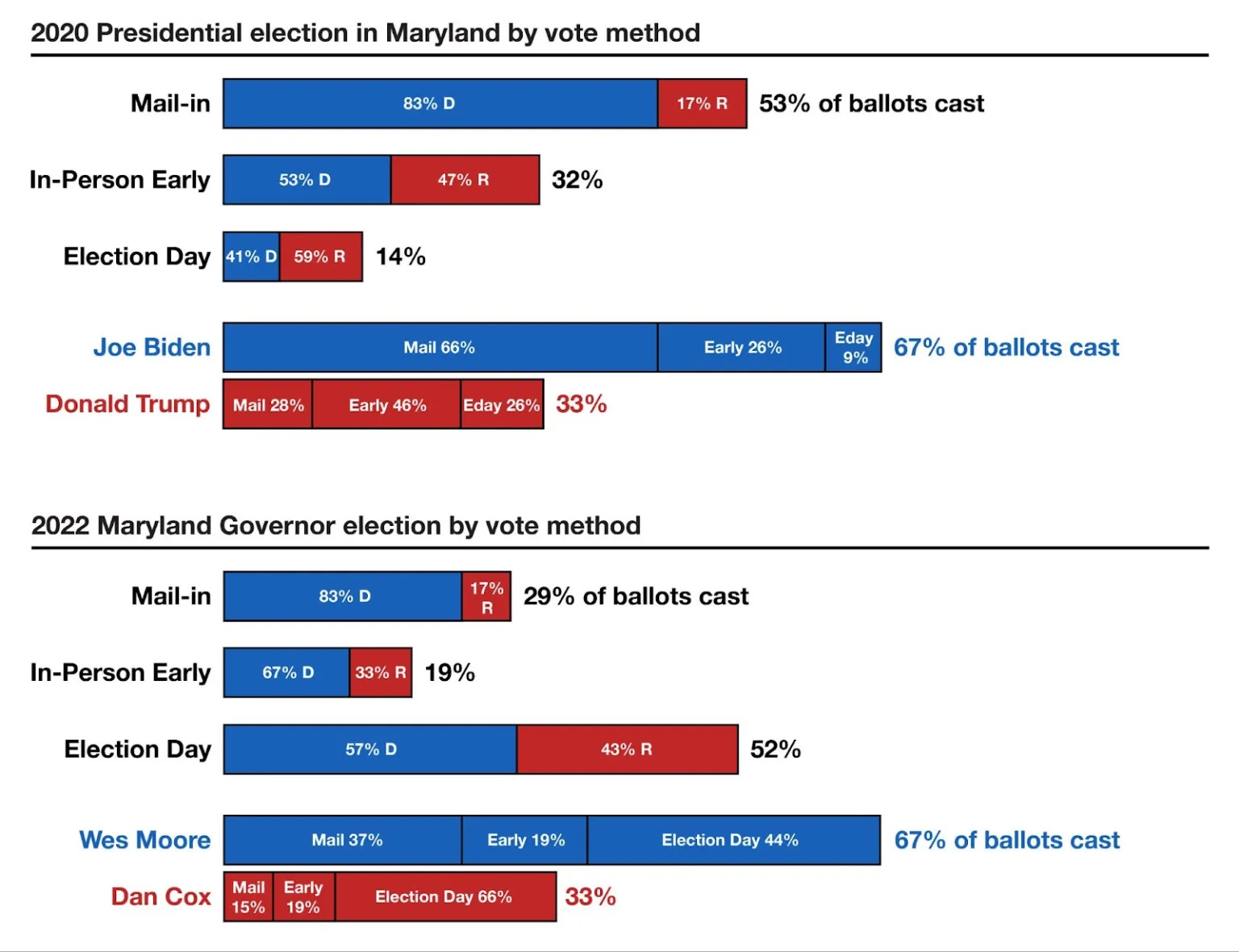
For red mirages showing Republicans with a potentially big lead early, watch out for Wisconsin, Michigan, and Nevada. For blue mirages showing Democrats with a potentially large lead early, look for North Carolina, Georgia and Pennsylvania. In Arizona, it is less clear. In 2020 and 2022, Democrats jumped out to massive, double-digit leads from EVIP and early arriving mail ballots but Republicans caught up and Biden only won by 0.3 points and Sen. Kelly won by 5 points. But in 2018, Republicans were up 3 and ended up losing by 2 because late arriving mail ballots skewed very Dem. Due to the early vote in Arizona being quite Republican by party registration, we might be seeing a reversion to the 2018 style, but it is hard to say.
Thoughts On the Presidential Race in Swing States
Pennsylvania
Pennsylvania is the most important state (or in this case, Commonwealth) because it is very hard to see either candidate win without its 19 electoral votes. According to FiveThirtyEight, if Harris wins Pennsylvania she has an 87 percent chance to win. If Trump wins the commonwealth, he has an 88 percent chance to win. President Biden won by 1.2 points in 2020, receiving exactly 50 percent. It is so divided in recent presidential elections because Democrats’ strong performance in Philadelphia and the Pittsburgh area is largely canceled out by blood red rural counties and medium-sized cities, to a lesser degree.
Harris’s path to victory comes from juicing turnout in Philadelphia, Pittsburgh and increasing her margins in the Philly suburbs while holding Biden’s losses in white-collar, rural counties or only losing marginal ground, which would be canceled out by increased support in the suburbs. Ron Brownstein noted that there has been a decrease in the electorate among white non-college voters by 1.5 points in Pennsylvania, and 3 points in Michigan and Wisconsin and an increase in white college-educated voters and people of color. Trump is hoping he maintains his suburban losses and can shift some Black and Latino voters in Philly and Allentown to his column, which I am skeptical of.
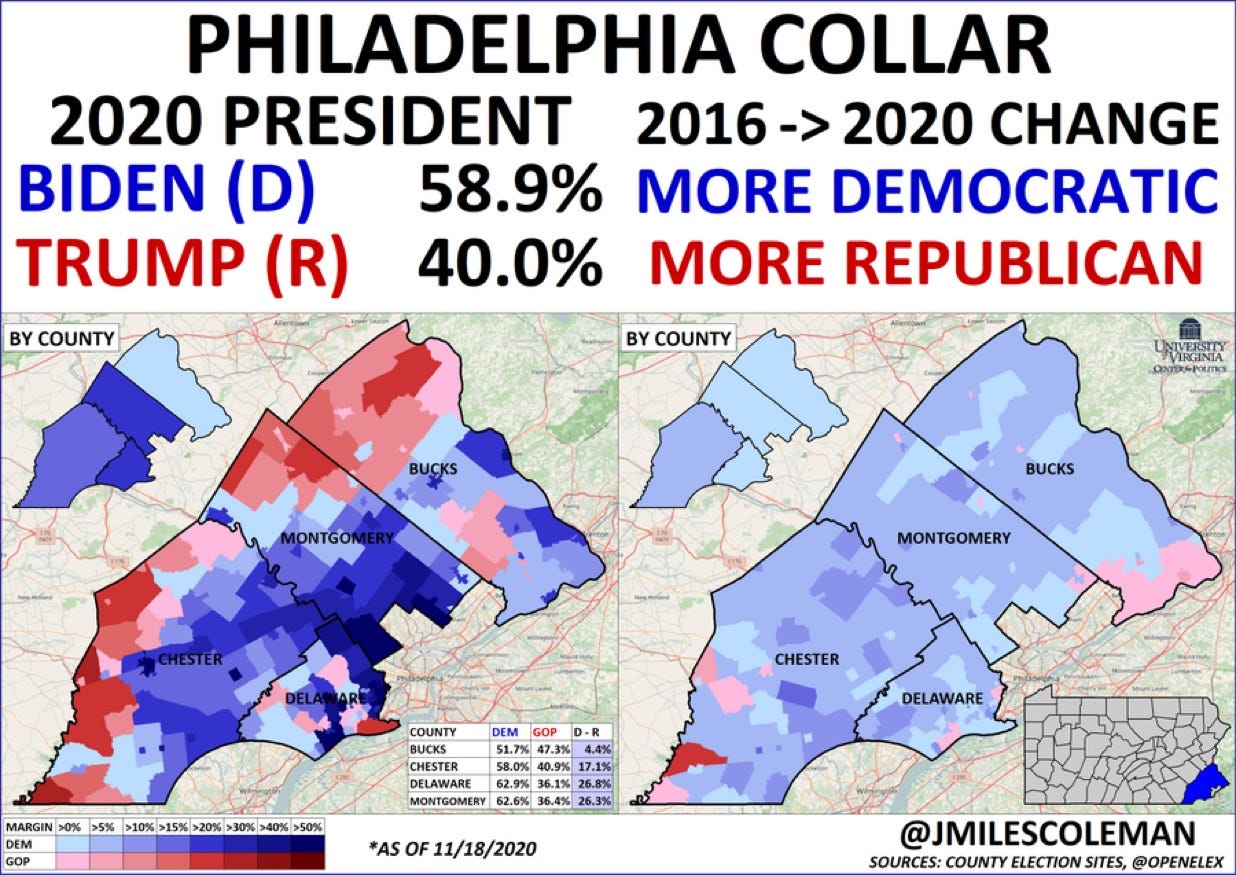
I will also be watching the “collar counties” of Bucks, Chester, Delaware and Montgomery. These are suburban counties that surround Philadelphia. They are historically Republican but have shifted to the left in the Trump era because they are populated with high earners and a have a high college education rate. In 2012, Obama carried these four counties by 10 points, 55%-45%. When Clinton lost PA, she won 55%-41% - same number as Obama but a larger margin due to bigger third party voters. Joe Biden won these counties by 19 points, 59%-40%. Can Harris get to 62 percent or more here? Her path to victory in all swing states runs through the suburbs and will be propelled by even larger support among college educated voters than what Biden had.
Two bellwether counties are Erie, the northernmost county which borders Ohio, and Northampton, which is in northeastern PA and part of the Lehigh Valley Metro area. Since 1976, Northampton has voted for the candidate who won Pennsylvania and except for 1976 and 2016, the margin of victory in Northampton matched the margin of who won PA within one point. Since 1952, Erie has voted with who won Pennsylvania each time except 1988, when it voted for Dukakis.
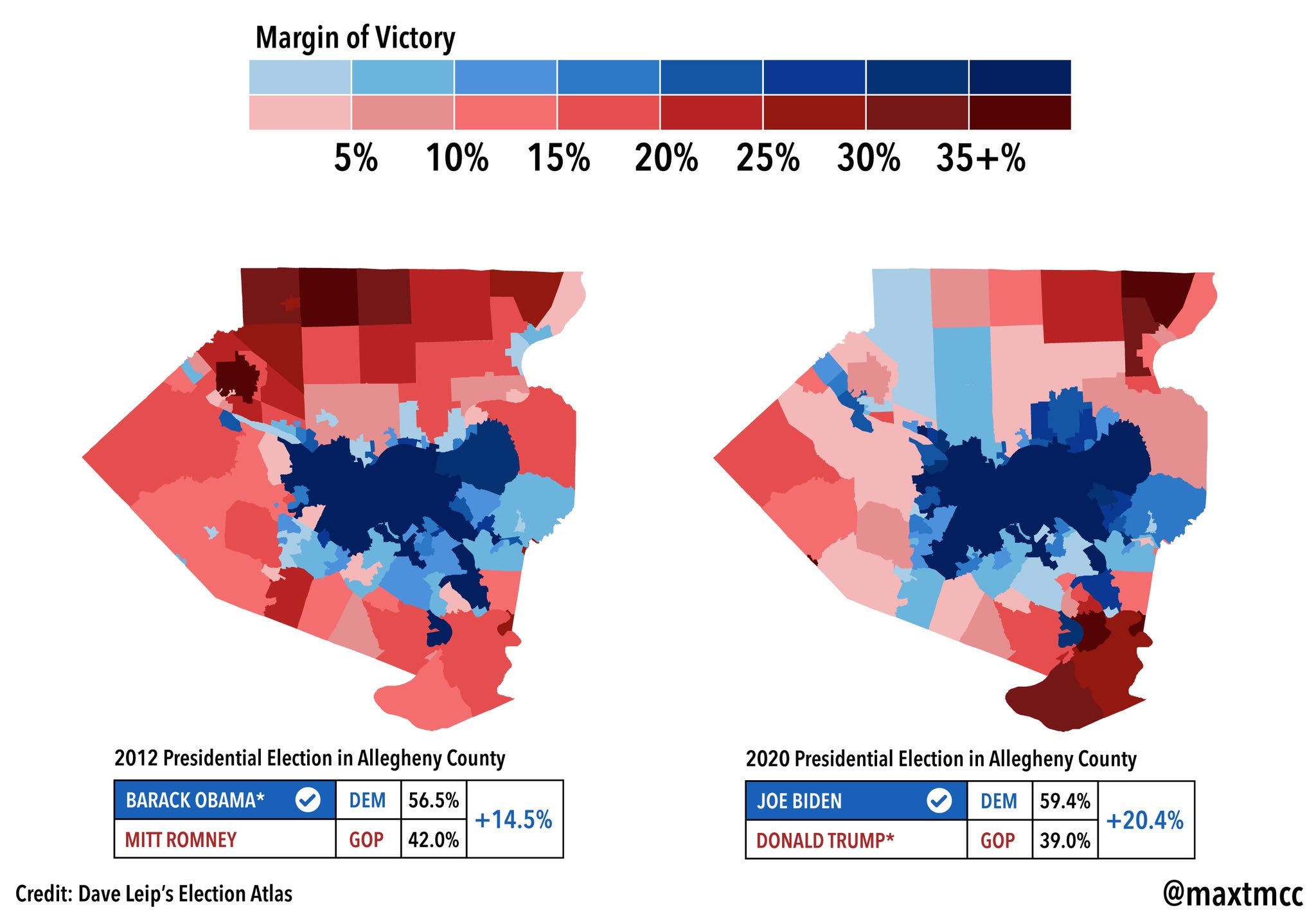
In Allegheny County, home to Pittsburgh and its suburbs, Democrats consistently won by 15-16 points since 1996 until 2020, when Joe Biden won by 20 points and nearly reached 60 percent. In Sen. John Fetterman’s 5 point win in 2022, he got 63 percent here and won by 28 points. Can Harris get 60 percent or higher? Can she improve upon Biden’s margin by 2-5 points? If there is any slippage here, it’d be a red flag for her.
Michigan
Michigan is likeliest state of the seven swing states to support Harris. Biden won it by 2.8 points and as mentioned above, white non-college voters have decreased as part of the electorate by 3 points.
Despite the media coverage about its ability to tilt the race, it is actually a minuscule part of the electorate and smaller than the margin Biden won by in 2020. In 2012, Obama won Oakland County, the highly college educated northern suburbs of Detroit, by 8 points, but Biden was able to win by 14 points. In Gov. Gretchen Whitmer’s 2018 victory, she was able to win here by 17 points. Can Harris match Whitmer’s 2018 margin?
Detroit, which gave Clinton and Biden 94 percent of the vote, had low turnout of 51 percent last time, which could have been because Democrats were not doing GOTV during the pandemic. Detroit’s City Clerk is projecting up to 290,000 ballots could be cast, equal to 55 percent turnout. It would be the highest raw turnout since 2012 and biggest percentage turnout since the pre-Obama years. If this came to fruition, this would be a terrific sign for Harris.
Wisconsin
Democrats perform better in rural counties here than in Pennsylvania, but the large bulk of their votes, of course comes from huge metro areas in Milwaukee and Madison. Going back many cycles, this has been the most competitive state, always being within one point either way except when Obama won by huge margins twice. I expect 2024 to be the same.
Dane County – a young, highly college educated area and home to Madison – provides Democrats massive margins. It has gotten bluer each cycle since this century and turnout is through the roof here. 89 percent of registered voters cast a ballot in 2020. Al Gore won Dane by 29 points in 2000, Obama won by 47 points in 2008 and Biden won by 53 points in 2020, reaching 75 percent. Can Harris crack 80 percent here or get closer to it?
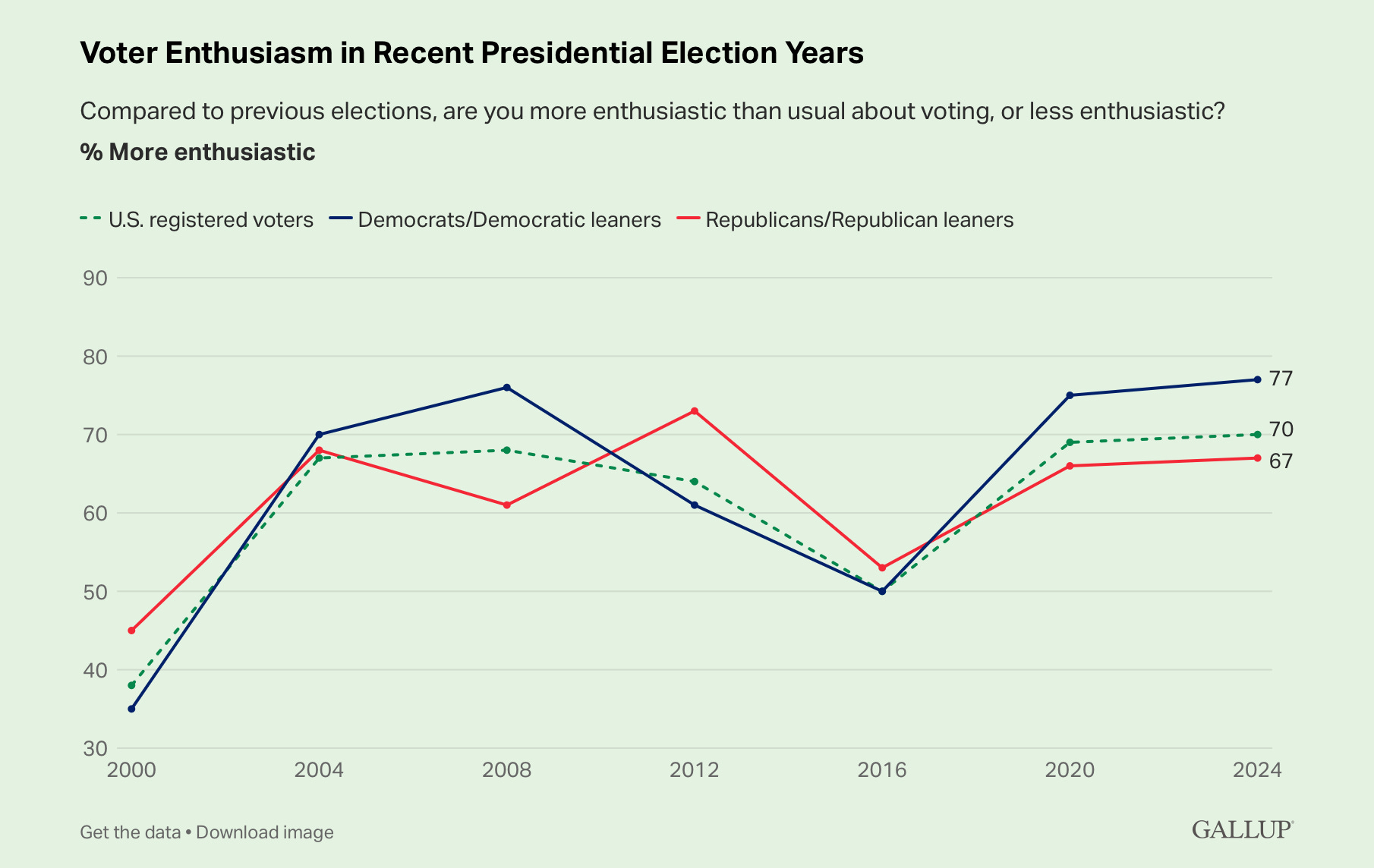
Milwaukee County, where Biden won by 40 points, has marginally improved since Obama won it by 36 points twice. However, in 2012 Milwaukee had an 86 percent turnout among registered voters, which far exceeded the poor 70 percent in 2016 and 76 percent turnout in 2020. Clinton had a huge enthusiasm problem and Dems didn’t do any in-person GOTV in 2020, though they did plenty of digital organizing. Harris has generated a level of enthusiasm among Dems not seen since 2008, according to Gallup. Can her candidacy get Milwaukee to 80-plus percent turnout again?
The WOW counties – Washington, Ozaukee, and Waukesha— are highly college educated suburbs north and west of Milwaukee. Though they have shifted to the left some since 2012, they have not moved as rapidly as in other swing states. Trump won the WOW counties by 23 points, a decline from Romney’s 35 point win here in 2012. Interestingly, neither Romney nor Trump received over 253,780 votes but Democrats increased their vote share from 2012 to 2020 by about 36,000.
Much attention has been paid to the WOW counties, but not enough paid to the BOW counties – Brown, Outagamie, and Winnebago. Obama did well here but Clinton’s support really plummeted in these areas, losing the BOW counties 52%-41%. Biden didn’t win a single county, but closed the gap only losing 53%-46%. Harris will want to lose by low to mid-single digits to feel good about winning statewide.
Georgia
President Biden became the first Democrat to win Georgia since Bill Clinton in 1992 with a 49.5-49.3 victory. Clinton lost by 5 points, so it rapidly shifted to the left in 2020, mostly due to the Metro Atlanta area becoming more Democratic. Interestingly, Trump’s vote share declined by just 1.3 percent from 2016, but Biden received 3.9 percent more support than Clinton. A little of this is 2016 third-party voters shifting to Biden, but more of it was 2016 non-voters and population increase from 2016 which was mostly young and diverse college educated professionals moving to the Metro Atlanta area.
The thirteen counties in the Atlanta metro area – Cherokee, Clayton, Cobb, Dekalb, Douglas, Fayette, Forsyth, Fulton, Gwinnett, Henry, Newton, Paulding, and Rockdale - is the big focus here. These counties make up over half of the vote in Georgia and voted for Joe Biden by a whopping 26.3 percent. Obama only won these by 15 percent. The core five counties which make up a significant portion of the electorate in Metro Atlanta are Clayton, Cobb, Dekalb, Fulton and Gwinnett - three of which are heavy Dem counties that have shifted or stayed the same. The other two are Romney-Biden counties which are historically Republican but are repulsed by MAGA and Trump and have shifted a lot to the left. Since 2012 here are the shifts in each of the five counties:
- Fulton, a majority non-white county, has shifted 16 points to the left
- Dekalb, a majority Black County, has shifted 11 points to the left, giving Biden a remarkable 83 percent
- Clayton, which has a 68 percent Black population, hasn’t shifted at all since 2012. It is the smallest county off these five but gives Dems massive margins, achieving 84 percent in each election since 2012.
- Cobb, now a majority non-white county, has moved a remarkable 27 points toward Dems. In 2012, Romney carried this county by 13, but Biden won it by 14 points in 2020.
- Gwinnett moved a stunning 27 point to the left, like Cobb. Biden received 58 percent of the vote after Obama only got 44 percent in 2012.
Arizona
Arizona, another historically conservative state like Georgia, shifted four points to the left in 2020. It has a large Latino population and high college education rate, too. There has been a narrative that Harris is slipping with Latinos relative to Biden in 2020 and that may happen, more so among Latino men.
If Harris loses here, Latino men shifting to Trump will likely be the reason. White college educated voters here, like many other states, detest MAGA Republicans and Trump. Harris is relying on big margins in Pima County (Tucson), high turnout among Native Americans, and “McCain Republicans” to carry her across the finish line. John McCain’s son endorsed her, and she has other moderate Republicans in the state backing her.
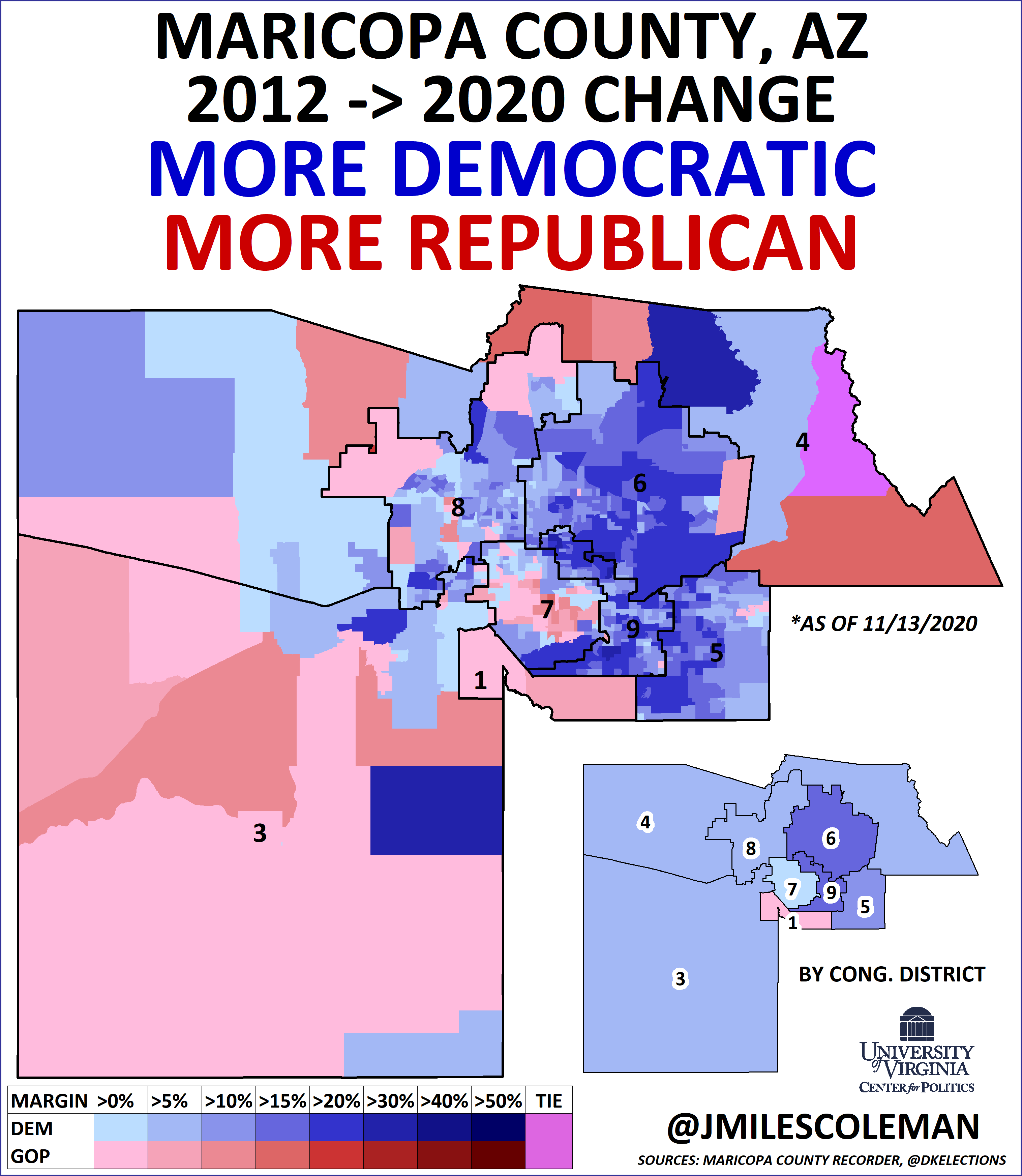
In Arizona, Marcipoa County is center of Arizona’s political universe. It represents more than 60 percent of registered voters. Harris probably needs to win Maricopa by at least 2 points to eke out a narrow victory. Biden became the first Democrat to win Maricopa since 1948, winning it by 2.3 points while he only won statewide by 0.4 points.
Nevada
Nevada is one of the most competitive states and on paper demographically would favor Republicans. It has the lowest college education rate of the seven swing states. But it is also a young state, and Democrats are backed by the powerful Culinary Union, which organizes very effectively and has a strong GOTV.
Clark County (Las Vegas) makes up about three-fourths of the state’s votes. Obama won by 19 and 15 points in 2008 and 2012, but Clinton only won by 11 solely due to increased third party support. Biden fell below a 10 point margin, only winning by 9 points, but this time it was due to Trump increasing his support from 41 percent to 44. Biden offset this by winning Washoe (Reno) by 4 points after Clinton only won it by 1. The rurals in Nevada are blood red. Harris will want to win Clark by 9-12 points to feel good and win Washoe by 2-4 points.
Typically, Democrats have a “firewall” of tens of thousands of votes from mail ballots – including before Covid – but this time Republicans have about a 42,000 vote lead before Election Day. However, unaffiliated voters make up a plurality of registered voters in Nevada and the skew very young and very Dem.
North Carolina
Since Obama won North Carolina in 2008, Democrats have come close but haven’t been able to do it again, losing by 1-3 points. This year, there is renewed optimism. Harris will want strong turnout in Charlotte and the Research Triangle and perform better than Biden – probably near Obama levels – among Black voters in the rural parts a of the state. Trump will want to limit losses in the suburbs and get massive rural support among white voters.
Mecklenburg County (Charlotte and its suburbs) went from Obama +22 to Biden +37, as he received 66 percent in 2020. Can Harris get to 70 percent here? Five suburban and exurban counties that surround Mecklenburg have only shifted 2 points to the left from 2012 to 2020 and is they key reason Democrats have not been able to win since 2008.
One county that has shifted is Cabarrus, which has experiences rapid population increase since the start of the century. Romney won here by 20 points, but Trump only won by 9. I doubt Harris will flip it, but can she only lose by 4 or 5? Wilson, a more rural area with 37 percent Black population has drifted to the right since the Obama years. Biden’s only won here by nearly 3 points. If Harris can get the margin up to 7-9 points, she could be in a better position to win.
Presidential Predictions
I think Vice President Kamala Harris will win, achieving 319 Electoral College votes and thus sweeping all seven swing states. The states I’m least confident in are Arizona and North Carolina. I think she ekes out very small wins there but can easily see Trump winning one or both. Moderate voters are tired of Trump’s bullshit in his third straight campaign. I think women - especially college students, senior women, and more Republican women than usual - are going to come out in massive numbers for Harris, largely because Roe v. Wade was overturned but also because Trump disgusts them. She has also had a significant fundraising and spending advantage and her advisors say late deciders are breaking for her by double -digits, which was validated by NYT surveys of the seven swing states this past weekend.
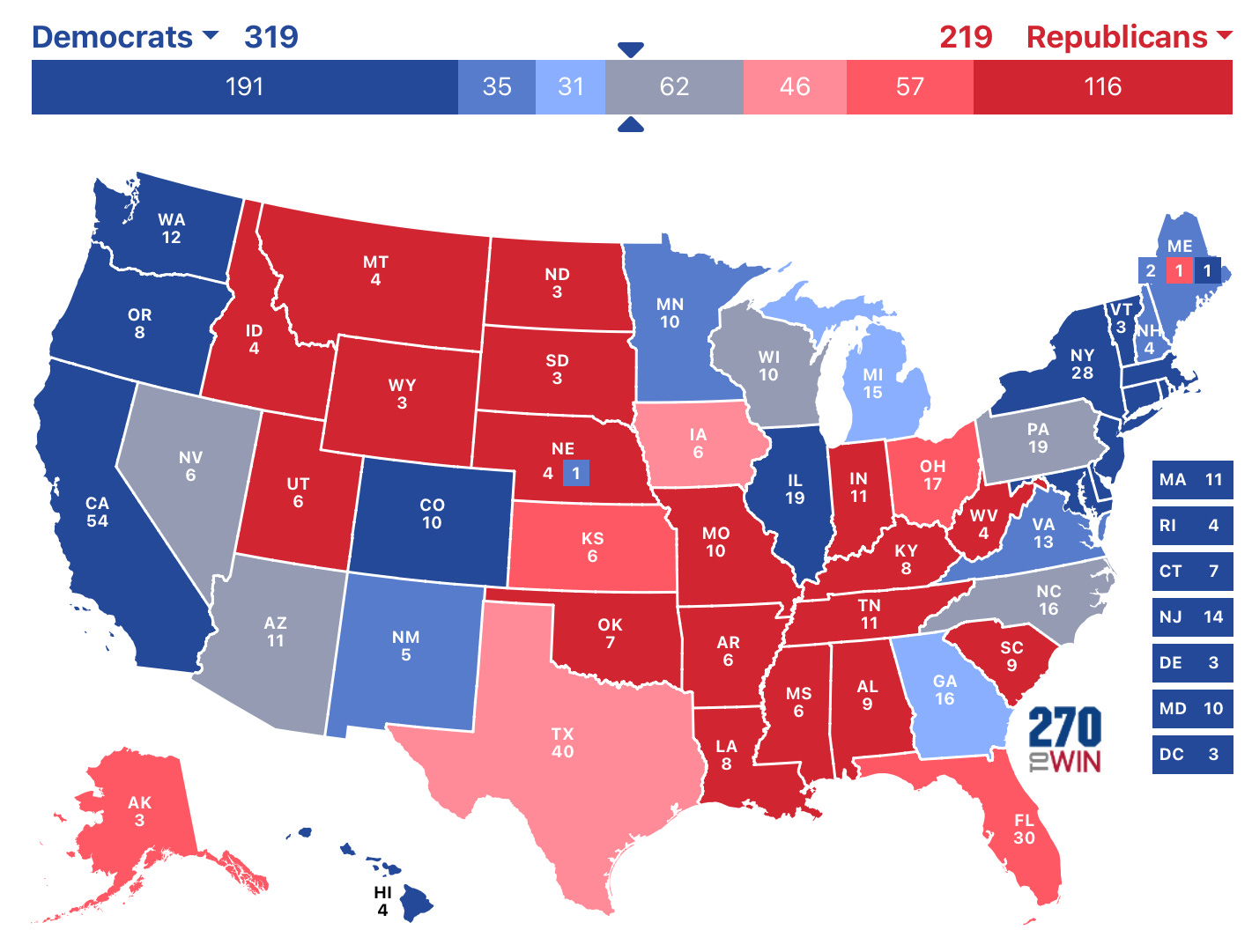
I think Harris will generate huge turnout among Black voters that we haven’t seen since Obama. Michigan will be her best swing state. She’ll win Wisconsin thanks to excellent organizing by the state party, big margins in Milwaukee and huge margins and turnout in Dane and continued Republican erosion in the WOW counties. I assume Harris will outperform Biden in the Philly suburbs and improve in Allegheny, too, en route to about a 2-point win in PA.
Although he is polling well in Georgia, there is a lot more room for Trump to fall in the Atlanta suburbs. Nevada is looking weak for Democrats in the early vote data (a rare state where it’s ok to analyze because it’s nearly all vote-by-mail state) but Dems will turn in ballots late and independents skew young and very Dem, which will give Harris a small victory, probably a bit smaller than Biden’s 2.4% win. I think Arizona will be the closest state and we won’t know the winner for days. Trump could easily narrowly win due to concerns over immigration, but I think she will eke out a small win because enough “McCain Republicans” still can’t stomach voting for Trump, big margins from Pima (Tucson) and high turnout among the Native American population. North Carolina is just a vibes pick and I feel least confident about this state.
Thoughts on the Senate
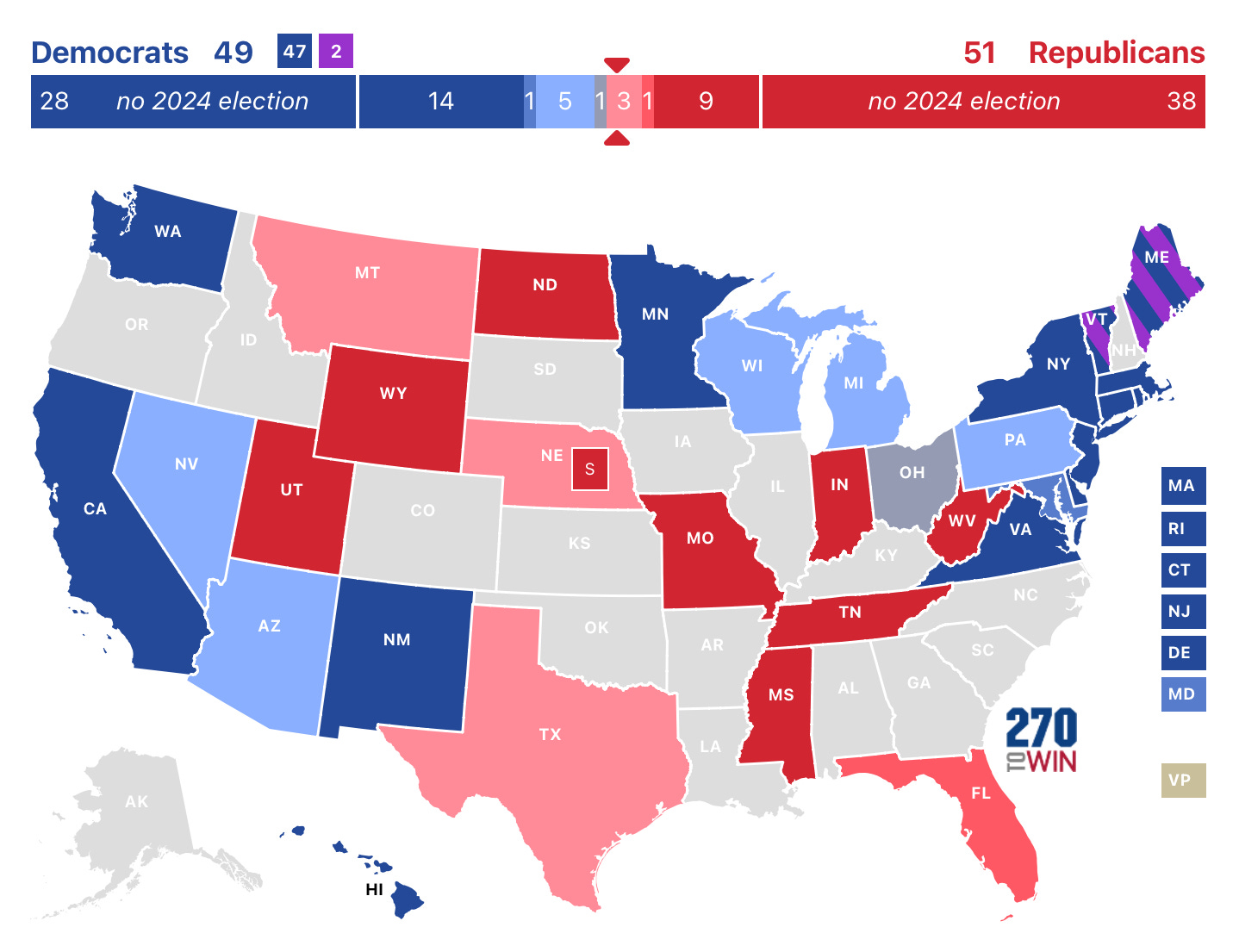
Democrats currently control the Senate 51-49, with four independents – Bernie Sanders, Angus King, Joe Manchin, and Kirsten Sinema - caucusing with them. Unfortunately, they face a brutal map this cycle and I project Republicans to control it 51-49 after this cycle. Joe Manchin is retiring, but he would’ve lost anyway if he ran again in deep red West Virginia, so that is an auto-flip for Republicans. Each party has fifty seats after that.
Sen. Jon Tester of Montana is in the toughest race of his life. He won in 2012 when Obama was on the ballot and in the 2018 midterms, but the electorate is far more polarized now, and Trump should win Montana by 14-16 points. Tester is a great senator and candidate but sadly I don’t think he can’t outrun the partisan lean of his state anymore.
Sen. Sherrod Brown hangs on by less than two points. He is also in the closest race of his career. Even though he only outperformed Obama by three points the only other time he’s run in a presidential year, his opponent sucks and I think he will hold his blue collar/rural losses and do extremely well in big cities and the suburbs. I think he can outrun a Harris loss of 8 points or less. I could easily be wrong, and Trump’s coattails will be enough to secure Bernie Moreno a victory.
Democrats sweep every other competitive race. Incumbents Bob Casey (PA) and Tammy Baldwin (WI) have closer than normal results but still win by anywhere between 3-6 points and easily outrun Harris. Jacky Rosen (NV) will win by 3-5, outrunning Harris by a bit. There are two open seats in Michigan and Arizona due to retirements which Democrats will both win, though Ruben Gallego in Arizona will have a more comfortable margin than Elissa Slotkin in Michigan. They are both very good candidates, but Slotkin’s opponent is pretty generic while Gallego faces Kari Lake, who lost the gubernatorial race in 2022 and spread lies about voter fraud. She is so toxic in Arizona that I see Gallego winning by about 5 points while Slotkin will win by 2-3 points. Gallego significantly outruns Harris, but Slotkin more closely matches the presidential margin.
Thoughts on the House
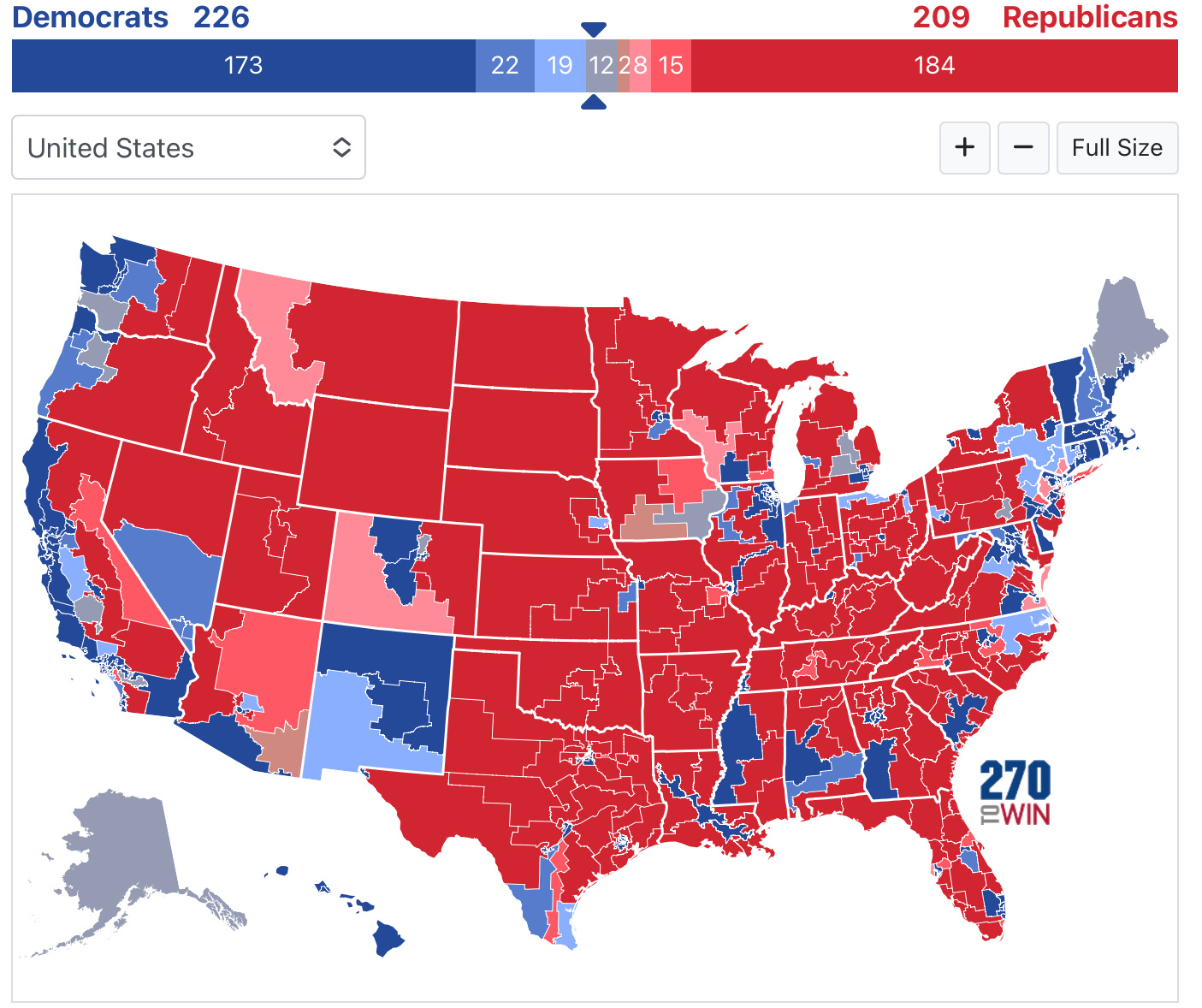
Republicans currently control the House 220-212. The consensus is there are about 20 “tossup” races, which I think will heavily break toward Democrats because of candidate quality, local issues, and the fact that there several Republicans in districts Biden won. I project Democrats control the House 226-209.
Democrats win three New York seats that Biden comfortably won – NY-04, NY-19 and NY-22 – but not a fourth in NY-17 because Democrat Mondaire Jones is an awful candidate. I predict they win one of the two competitive Arizona seats, AZ-01, because it is more college educated and a higher earning district. Republican David Schweikert only won by less than a point last time. Dems also win in IA-01 because Republican incumbent Mariannette Miller-Meek is disliked and because there’s enough of a backlash to Iowa’s six-week abortion ban
Dems also win all five competitive House races in California: CA-27, CA-22, CA-13, CA-41, CA-45, and CA-47. CA-47 is in costal OC where I grew up which contains heavily Dem cities of Laguna Beach, Costa Mesa and Irvine, light blue Seal Beach, and Republican cities Newport Beach and Huntington Beach. CA-45 includes parts of Fullerton, Brea, Westminster, Garden Grove, Cypress, Fountain Valley and Los Alamitos. It is heavily Vietnamese which should benefit Derek Tran. Michelle Steel’s opponent ran a poor campaign in 2022. Dave Min being from Irvine will help juice turnout and provide him big enough margins for a modest win in CA-47.
CA-13, based outside Modesto with parts in the Central Valley, had very poor turnout in 2022 which doomed Democrat Adam Gray. He is running again in a district Biden won by 9 and Harris’s margin should put him over the top. There is another 2022 rematch in CA-22, which is majority Latino and includes Dem leaning Kings and parts of Tulare and Kern in the Central Valley. A recent survey had Harris up double-digits matching Biden’s margin and Salas narrowly up. She will carry him here. Mike Garcia in CA-27, which includes Santa Clarita and Palmdale, is in huge trouble. Harris should win this district by double digits – or close to it. Garcia faced the same weak opponent for the last three elections and finally faces someone who is stronger and better funded. Democrat George Whitesides will win by a few points. Lastly in CA-41 Ken Calvert is in the only district of these five Trump won so it is more feasible he will hang on to win. Will Rollins, who is gay, is well funded and running a great campaign and I think the inclusion of the heavily Dem city Palm Springs will propel Rollins to victory.
There are several Democrats in districts Trump won who will all narrowly hang on because they are great candidates and/or have weak opponents. Matt Cartwright (PA-08), based in Lackawanna and Luzerne, has consistently outrun Dems at the top of the ticket in the Trump era. He has a strong brand locally and will win again. Marie Glusenkamp Perez (WA-03), which includes Vancouver’s suburbs and a lot of rural southwestern Washington, will win a very tight race again despite Trump winning by four points in 2020 because she is facing a right wing and toxic candidate in Joe Kent, who she defeated in 2022. Jared Golden (ME-02), who represents rural and Trump-friendly Maine, will barely win again because he is well-liked and has separated himself from the national party well. Mary Peltola (AK-AL) is in the most Republican House seat as Alaska voted for Trump by ten points but is very moderate and well-liked. Even Republican Senator Lisa Murkowski said she hoped Peltola wins.